

If I had a dollar (ok, a $100) for every time a client walked in and said, “Guy, I’m just so stressed,” I could retire. Stress has a terrible reputation. We treat it like a villain — something to eliminate, escape, or medicate away.
In late 2025, I finished a course on sleep, stress management, and recovery through Precision Nutrition, and it gave me a completely different way to think about stress. One that I believe can change how you see not just your workouts, but the hard things in your life.
Here is the big idea: stress isn’t the enemy. Stress is the raw material of getting stronger. The question is never “how do I avoid stress?” It is “am I getting the right amount and am I recovering from it?”
Your body was built for this
Think about what happens when you start exercising after time off. Day one is hard. You are sore for two days. Your body is sounding the alarm. This is the stress response, and it is completely normal. It is your body saying: something new is happening; pay attention.
Then something remarkable happens. You rest. You sleep. You eat. And your body doesn’t just return to where it was; it rebuilds a little stronger. That is why week three of training feels easier than week one. Your body adapted.
That is the whole pattern of stress, and it applies far beyond exercise: baseline → challenge → a temporary dip where things feel harder → recovery → a new baseline, slightly better than before. The dip is not a sign something is wrong. It is the doorway to getting stronger.
The sweet spot
Look at the graph below. It is called the stress curve, and it is one of the most useful pictures I have ever seen for understanding how we feel day to day.
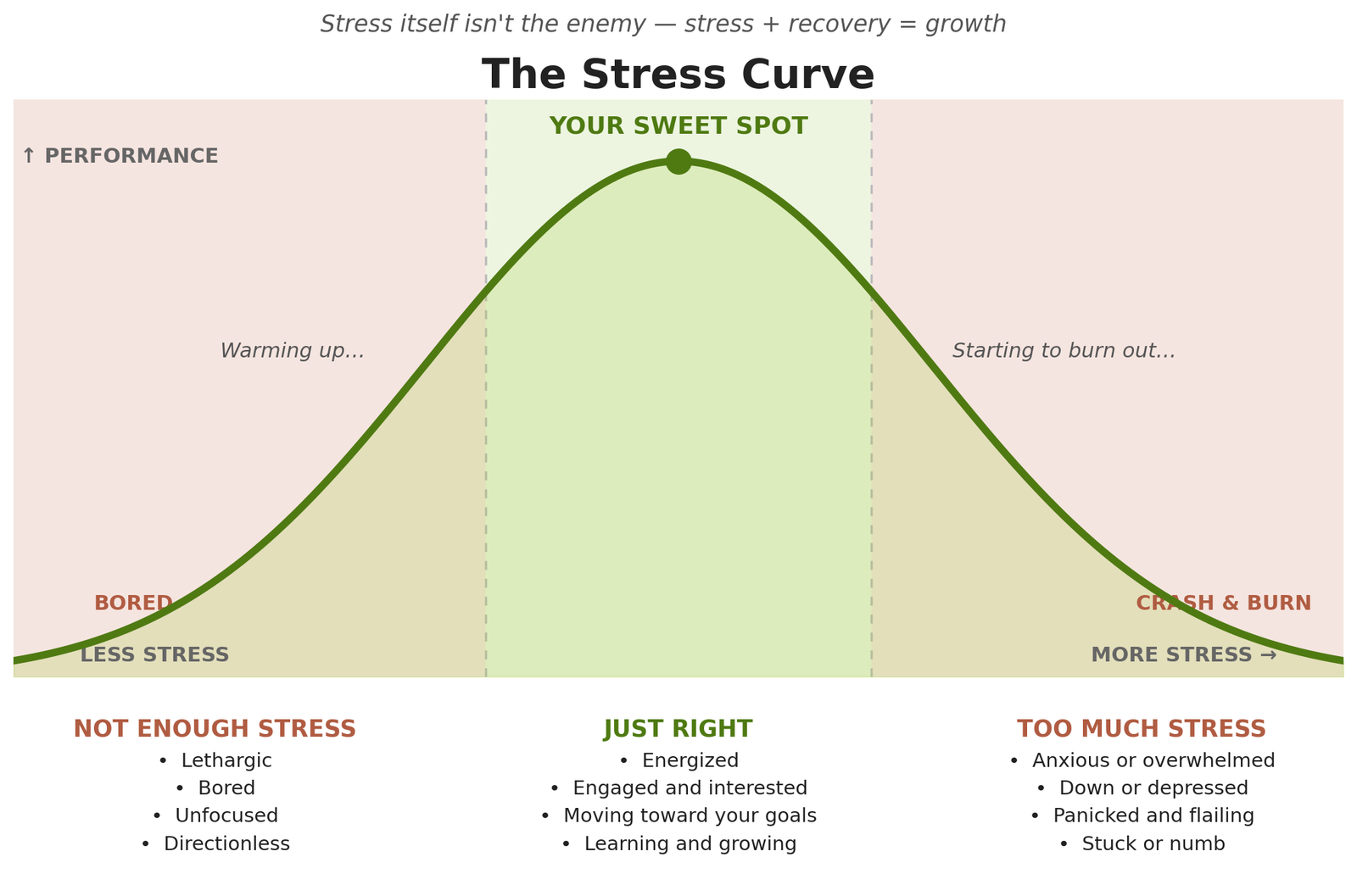
On the left: not enough stress. Bored, lethargic, unfocused, drifting. A life with zero challenge goes stale fast.
On the right: too much stress. Anxious, overwhelmed, stuck or numb; the pile-up of too many demands at once, with no breathing room.
And in the middle: just right. Energized, engaged, moving toward your goals — enough challenge to light you up, not so much that it flattens you.
Nobody tells you this part: your sweet spot is yours alone. The same challenge that energizes one person overwhelms another. Part of our job together is finding yours.
Good stress vs. bad stress
So what separates stress that builds you up from stress that breaks you down? It is not the stress itself — it is two things: recovery and mindset.
Good stress is short-lived; it is chosen (or at least meaningful), and this is the big one: it is followed by recovery. A tough workout is good stress: intense for an hour, then you rest, eat, sleep, and come back stronger. A roller coaster is good stress: scary for ninety seconds, thrilling afterward. Bad stress is chronic and relentless, with no recovery in sight. It piles up faster than your body can clear it.
The formula I took away from the course, from coaches Brad Stulberg and Steve Magness, is simple: stress + recovery = growth. Stress without recovery is just wear and tear. But stress with recovery is how muscles, bones, confidence, and resilience are built.
Your mindset changes your chemistry
Here is the part that surprised me most. How you think about stress actually changes how your body responds to it.
When you see your racing heart before a challenge as your body gearing up to help you — fueling your muscles, sharpening your focus — your body responds one way. When you see it as proof that something is wrong with you, your body responds another way entirely. Same heartbeat, different story, different chemistry.
Researchers call this “stress mindset”: people who see stress as a natural, useful response to a meaningful challenge handle it better — physiologically, not just mentally.
So the next time you feel that flutter of nerves, before a new exercise, a presentation, a hard conversation, try this reframe: “This is my body getting ready to do something that matters.” It is not a malfunction. It is mobilization.
Your October game plan: the 3 Rs
Each lesson in the course ended with a simple plan, and I am stealing it for you. Three Rs:
1. Respond. When stress hits, pause before you react. Take one slow belly breath — breathe in so your belly expands, then brace your core like you are about to lift something (you already know this move from our bracing work!). That single breath switches you from panic mode to thinking mode.
2. Recover. Recovery is not laziness — it is the other half of the growth formula. Sleep is the king of recovery. So is real food, so are rest days between workouts, so is a walk instead of a scroll. You cannot out-train chronic under-recovery, and you cannot outlive it either.
3. Rebuild. Once you have recovered, go back and take on the challenge again — a little bigger this time. That is how the new baseline gets built. Progress is just this cycle, repeated patiently: stress → recover → rebuild → repeat.
What this means for your training
This is exactly how we design your sessions at Corefit. Every workout is a carefully measured dose of good stress — enough to nudge you out of the bored zone and into the sweet spot, never so much that you land in crash-and-burn territory. And your rest days? They are not days off from progress. They ARE progress. That is when the rebuilding happens.
So the next time a session feels hard, remember: the hard is the point. The dip is the doorway. Stress plus recovery equals growth — and that is not just a saying; it is literally how your body works.
So check in with yourself this October: where are you on the curve? If you are not sure, bring it up in your next session — finding your sweet spot is what I am here for.
And if you know someone who has been saying “I’m too old to start” — tell them stress is how we grow at any age. We will meet them exactly where they are.
Train smart,
Coach Guy