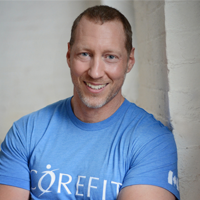
When you start at Corefit, we don’t hand you dumbbells and say go. After our consultation and assessment, and after discussing your goals — keeping up with the grandkids, getting stronger, moving without pain — every new client learns the same two skills: how to brace and how to hinge.
I even made a short video walking you through both: Watch: Bracing & Hinging (3:50). Here’s why these two movements matter so much — especially after 50 — and why they’re the foundation of everything we do at our Mississauga studio.
You’re Already Hinging Dozens of Times a Day
Think about your yesterday: groceries out of the trunk, the laundry basket, getting down to your grandchild’s level, reaching into the garden. Each moment asked your body to do the same thing: fold forward, pick something up, stand back up.
Most back injuries don’t happen in the gym; they happen in the kitchen, the driveway, and the garden, in the split second someone rounds their lower back to grab something and feels that sharp twinge. The hip hinge is the safe version of that everyday bend: your hips push back, your back stays flat, and your powerful leg and glute muscles do the lifting instead of your lower back.
How to Brace Your Core: Your Body’s Natural Weight Belt
But before you hinge, you brace.
Bracing is not sucking in your stomach. It’s the opposite. You take a “belly breath” — breathing in so your ribs and belly expand outward — then squeeze your abs tight around that breath. As I say in the video, you’re “creating a natural belt using my anatomy,” a cylinder of pressure that protects your lower back every time you lift, bend, or carry.
Why does this matter so much after 50? Because the spine you protect today is the spine you’ll rely on tomorrow. A proper brace turns your midsection into a stable column, so the lifting force travels through your legs and hips instead of shearing across the small joints of your lower back.
Most new clients have never braced on purpose before. Within one session, they’re doing it — and within weeks, they’re doing it without thinking.
The Wall Drill: How We Teach the Hip Hinge
We teach it with a wall, not a lecture.
Here’s the drill I walk through in the video:
- Stand a few inches in front of a wall, feet hip-width apart.
- Take your belly breath and brace at the top.
- Push your hips straight back until your butt touches the wall.
- Breathe only at the top, re-brace, and repeat.
The wall gives you a target, so you stop guessing. Your back stays flat because your hips do the moving. It’s simple, and it works — even for clients who arrive saying, “I’ve got a bad back, I can’t bend like that.”
For sensitive backs, we start small: 5 to 8 reps per set, often but not too much, progressing gradually. We add weight only once you’re stronger and the pattern is solid.
Why Brace and Hinge Comes Before Everything Else
Every Corefit program is tailored to the individual. It starts with a complimentary 30-minute fitness consultation and assessment at our studio: you meet me, we talk about your goals and your health history, and we design a personal program around you.
But brace and hinge come first — before the tailored part — because they’re non-negotiable. They’re the difference between a program that builds you up and one that breaks you down.
Once you can brace and hinge, everything else unlocks safely: the deadlift pattern behind carrying groceries, the squat pattern behind rising from a chair, the carries that build real-life strength. Skip the foundation, and the whole house wobbles.
This is what I mean when I say our training is about body mechanics, not just workouts. Anyone can make you tired. Our job is to make you move well — and then make you stronger on top of good movement.
What Your First Weeks at Corefit Look Like
Here’s how it actually unfolds:
- Your free consultation and assessment. We listen to your goals, review your health history, and watch how you move.
- Your first sessions. We teach you to brace and hinge — using the dowel technique and the wall drill — until it feels natural.
- Then. We build your tailored program around your goals, layering strength, balance, and mobility on top of the solid mechanics you’ve learned.
Clients are often surprised these bracing and hinging basics make the biggest difference. After a few weeks, daily life feels easier: getting out of the car, lifting the laundry, playing on the floor with the grandkids.
Frequently Asked Questions
Bracing means taking a deep belly breath — expanding ribs and belly outward — then squeezing your abs tight to create pressure around your spine. It’s a natural weight belt for your lower back.
A hip hinge is bending at the hips — pushing your hips backward while keeping your back flat — instead of rounding your lower back. It’s the safe way to pick things up, and the foundation of deadlifts and good everyday posture.
When taught properly and progressed gradually, yes — it’s one of the best things you can learn for a sensitive back. We start with a simple wall drill, just 5 to 8 reps at a time, and only add load once the pattern is solid. Every movement is tailored to your health history.
Ready to Move Better?
Learning to brace and hinge starts with a conversation. Book your complimentary 30-minute fitness consultation and assessment at our Mississauga studio, meet Coach Guy, and let’s build a plan around your goals.
Live Healthier. Move Better.